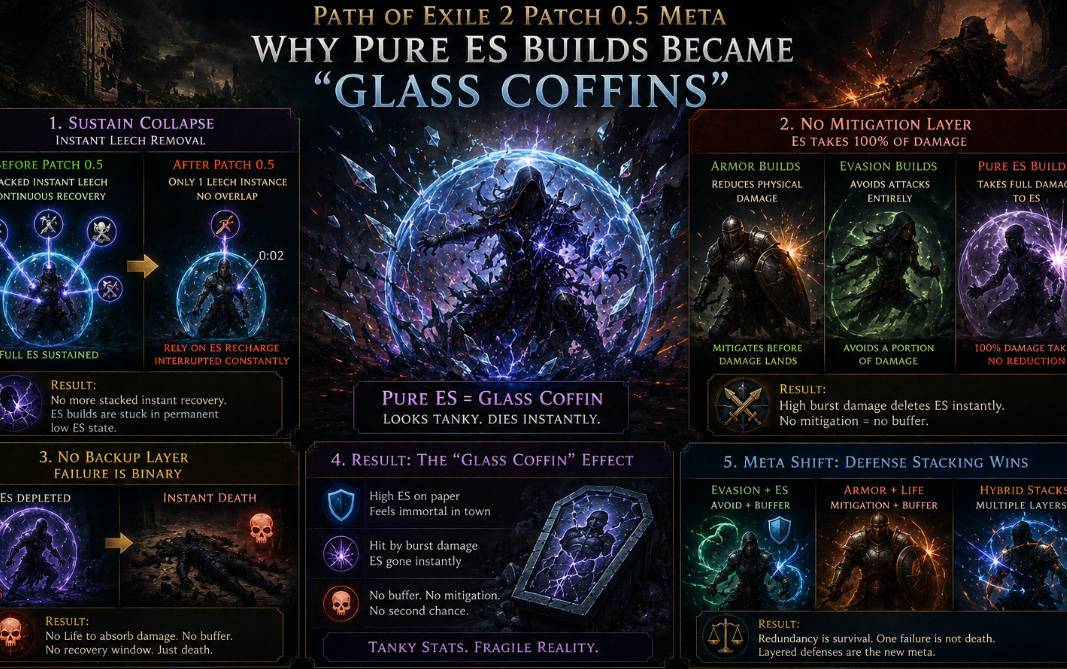
In Path of Exile 2 Patch 0.5, pure Energy Shield (ES) builds have shifted from being one of the safest endgame defenses to one of the most fragile archetypes in the game. The reason is not a simple numerical nerf, but a structural breakdown of how ES sustain and mitigation used to work.
- Sustain Collapse: Instant Leech Removal Breaks the Core Engine
The first and most critical issue is the change to leech mechanics. Patch 0.5 introduces a strict rule: only one active leech instance per resource pool can exist at a time.
This single change dismantles the previous ES sustain model. In earlier versions, ES builds relied on overlapping instant leech sources to rapidly refill thousands of Energy Shield within seconds. Sustain was effectively continuous as long as damage output was maintained, making poe 2 currency investment into high-end gear feel disproportionately rewarding in terms of survivability scaling.
Now, that system no longer exists.
Without stacked instant recovery, ES builds are forced to rely on Energy Shield recharge. The problem is that recharge is not combat-stable: it is frequently interrupted by incoming hits and damage-over-time effects. In high-density endgame encounters, this means recharge rarely completes. The result is a permanent “low ES state” rather than full recovery cycles.
- No Mitigation Layer: ES Alone Cannot Reduce Incoming Damage
The second structural weakness is that pure ES builds lack any inherent damage mitigation.
Unlike armor or evasion-based defenses, ES provides no reduction against physical or elemental burst damage. This becomes critical in Patch 0.5, where enemy damage profiles have shifted toward higher burst potential, including heavy physical slams and hybrid chaos attacks.
As a result:
- Armor builds reduce large hits before they land
- Evasion builds avoid a portion of incoming attacks entirely
- Pure ES builds take full damage directly to the shield pool
This creates a mathematical disadvantage: ES must absorb 100% of damage with no reduction layer. Even large ES pools (10,000–15,000+) can be erased instantly by high-end boss attacks if no mitigation exists.
- No Backup Layer: Failure Is Binary, Not Gradual
The third and most punishing flaw is structural: pure ES builds have no secondary health layer.
Once ES is depleted:
- There is no Life pool to absorb overflow damage
- There is no buffer against consecutive hits
- Recovery time is effectively zero under pressure
This creates a binary outcome: either ES holds completely, or the character dies instantly. There is no “graceful degradation” of survivability.
In modern high-pressure mapping environments filled with ground damage, fast AI aggression, and overlapping burst mechanics, this binary system becomes unreliable.
- Result: The “Glass Coffin” Effect
When all three weaknesses combine—sustain failure, lack of mitigation, and absence of a backup layer—pure ES builds produce a paradox:
They appear extremely tanky on character sheets, but collapse instantly in real combat.
This is why the community describes them as “glass coffins.” They look like endgame immortality builds but function like single-layer defenses with no redundancy.
- Meta Shift: From Single Layer to Defense Stacking
The current meta in Path of Exile 2 has therefore moved toward hybrid defense layering.
Successful builds now combine multiple systems:
- Evasion + ES for hit avoidance plus buffer sustain
- Armor + Life for consistent physical mitigation
- Full hybrid stacks combining evasion, armor, and a secondary pool
The key principle is redundancy: every build must survive at least one failure point.
Patch 0.5 does not simply nerf ES—it removes the possibility of single-layer defense dominance. Pure ES fails because it depends entirely on one system (sustain) that is no longer reliable, while also lacking mitigation and backup layers, making it far more dependent on efficient poe 2 currency investment just to reach baseline survivability thresholds.
In the new environment, survival is no longer about maximum numbers. It is about layered defense architecture.